Search this site ...
Contemporary African Art
Contemporary Art is, by its very nature, fluid, self-motivated and resists classification.
Contemporary African Art is difficult to categorize just as singularly defining 'art' in the 21st Century is virtually impossible. In fact, most art directors, curators and historians would, today, be extremely hesitant to commit to such a definition.
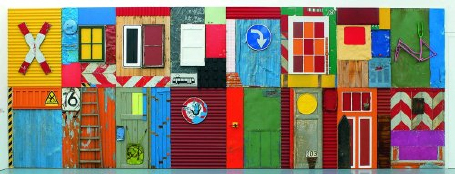
Contemporary African Art particularly cannot be generalized and reduced to a singular concept simply by the fact that there are many art scenes happening all over Africa and each is fuelled by its own contextual parameters.
What does it mean and who is 'African', just who does one include?
An indigenous African artist who lives and works on home territory is an obvious starting point, but what about those that travel between two worlds? Or even those who have never put a foot in Africa but their heritage is African and their work is inspired by and reflective of this legacy? And what about those white Africans who come from European stock one, two or even three centuries ago? Do they have as much claim to be included in the framework as their black counterparts?
Afropolitanism is the voguish term for new work made by young African artists both in and outside Africa. The artists are presumably united by some shared view of Africa but this seems preposterous given that their cultures are widely varied, their geographical locations scattered, their personal stories and journeys vastly disparate. I, like Holland Cotter of the New York Times, choose to defend an artist's right not to 'wrap themselves in evidence of their origins'. Their work will demonstrate, up to that point of creativity, a personal reflection of everything that has defined them and contributed to their mode of existence.
Their 'Africanness' of contemporary African art may, or may not, be perceptible or relevant to the subject matter but it is inherent in their nature and therefore their work.
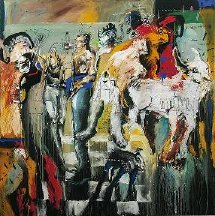
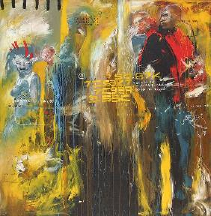
Contemporary is about the now; belonging to or occurring in the present. If we describe someone as a modernist we recognize that they have achieved a significant departure from traditional styles or values. Within the context of contemporary African art there are many African artists who exist contemporaneously as a modernist and a contemporary one.
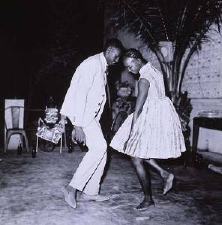
- Bruly, Frederic Bouabre b 1923, Ivory Coast
- Salahi El, Ibrahim b 1930, Sudan
- Glover, Ablade b 1934, Ghana
- Mahlangu, Esther b 1935, South Africa
- Onobrakpeya, Bruce b 1932, Nigeria
- Sadibe, Malick, b 1935, d 2016 Mali
- Tokoudagba, Cyprien b 1939, Benin
- Sudan Sekano, Charles b 1943, SA/Kenya
These artists have pushed boundaries at many stages of their careers and most of them still continue to do so. They are valued today for not only their contribution to aesthetic and cultural history but they were also often involved in international discourses on evaluating modernity in contemporary African art on the continent of Africa and mediating its place on the world art scene.
It is important to acknowledge that African men and women chose to master the new technologies presented to them and used them within their own local frameworks to contribute to a budding modernity on the continent.
The true African Modernists were real protagonists as they sought to maintain cultural responsibility and expression under the constraints of colonialism.
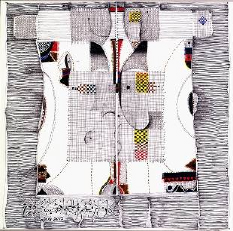 Ebrahim El Salahi
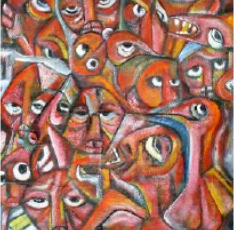 Malangatana, red
There are a number of artists who we can repute with being the forefathers of African modernism; their visual language is as pertinent to the larger history of 20th Century contemporary African art as that of post-colonial artists:
- Bakker, Kenneth 1926-1988, South Africa
- Depara, Jean 1928-1997, Angola/DRC
- Egonu, Uzo 1931-1996, Nigeria
- Enwonwu, Ben 1917-1994, Nigeria
- Hodgins, Robert Griffiths 1920-2010, South Africa
- Ibeto, Christopher 1912-1995, Nigeria
- Khumalo, Sydney 1935-1988, S Africa
- Kwami, Dr Grace Salome Abra 1923-2006, Ghana
- Mancoba, Ernst 1904-2004, S Africa
- Malangatana, Valente Ngwena b 1936, d 2011, Mozambique
- Mukomberanwa, Nicholas b 1940 d 2000, Zimbabwe
- Lilanga Di Nyama, Georges 1934-2005, Tanzania
- Ndiaye, Iba 1934-2008, Senegal
- Olatunde, Asiru 1918-1993, Nigeria
- Onabolu, Aina 1882-1963, Nigeria
- Oni-Okpaku, Chief Gabriel 1938-1977, Nigeria
- Pemba, George 1912-2001, S Africa
- Sekoto, Gerard 1913-1993, S Africa
- Skotnes, Cecil 1926-2009, South Africa
- Thango, Francis 1936-1981, Congo
- Tingatinga, Edward Saidi 1932-1972, Tanzania
- Twins, Prince Seven Seven b 1944 d 2011, Nigeria
- Villa, Edoardo b 1915 d 2011, South Africa
African modernities were very often enclosed within resistance movements which had given birth at the same time as the infliction of colonial rule. Some of these movements such as the sign painting of Nigeria grew in force and courage revealing themes of subjugated humiliation as the decades progressed.
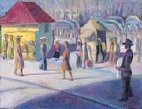 Gerard Sekoto,Market St scene
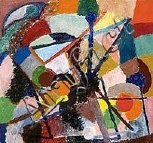 Ernest Mancoba,
Untitled, Art Fact
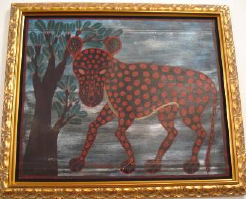 Tingatinga, Joburg Art Fair, 2010
Colonialism introduced a whole new world of ideas and artistic disciplines to contemporary African art within Africa. Art schools and technological colleges, workshops and studios were set up by the colonial regimes introducing new artistic disciplines like easel painting and photography.
Representational art took over from idealization and the traditional language of African creative and spiritual expression. This was ironically happening at the same time as Europe and the Western world were absorbing the reverberations of the dynamic shift of Picasso and his contemporaries into cubism and the liberation of line, shape, colour and form.
Since 1910, art had no longer been purely visual but was now conceptual and societal as well.
Some of these African modernists like Mancoba and Sekoto escaped the confines of their imposed cultures and went to London or Paris where they were exposed to Western art and all its history including the impressionists, post-impressionists and the developing avant garde.
In Paris, Enwonwu was exposed to 'Negritude', a black affirmation movement and this gave his work a sophistication way above his counterparts at home. However, despite long sojourns away, they returned to their countries of birth to embrace new directions and the influences of political and social changes on the continent and to strive for world recognition of the existence of an African modernism within contemporary African art.
Colonial Heritage in African art development
Artistic activities in Africa during colonial times fell into two areas, those that were defined by direct Western influence such as in Schools of Art and craft workshops set up by the colonial governments and sometimes well-meaning, paternalistic individuals wishing to make a mark in Africa.
Otherwise contemporary African art developed in specific local situations and had distinct characteristics, some of which have survived to this day...
- Ghana, Accra, Achimota College, 1936
- Uganda, Kampala school of Fine Arts at Makerere, 1939, easel painting introduced by Margaret Trowell from the UK
- Nigeria, 'Murray' school, 1930's and 40's, founded by Government officer Kenneth C Murray, produced artists like Ben Enwonwu
- Congo, 1940-1950's Lubumbashi School, founded by Belgian Pierre Romain Des Fosses
- Sudan, Khartoum Technical Institute, 1946, still surviving and hugely instrumental in fostering African art today
- French Congo, Brazzaville 1951, Poto Poto school founded by Pierre Lods
- Nigeria, College of Arts, Science and Technology, 1953 and Yaba School of Technology in 1955
- Nigeria, Oshogbo School, 1962, founded by Ulli Beier and produced artists like Prince Twins Seven Seven and Chief Jimoh Buraimoh
- Nigeria, Zaria Art Society
- Zimbabwe, Shona sculpture, mid 1950's, founded by Frank McEwan and Thomas Mukarobgwa, National Gallery, Harare
- Tanzania/N Mozambique, Makonde sculpture
- Senegal, Dakar School, early 1960's
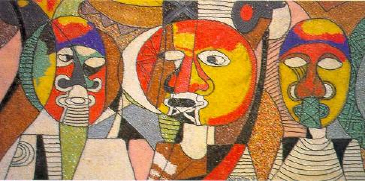
Workshops and craft initiatives
Post-colonial euphoria
By 1980 most African countries had achieved independence from their foreign governing regimes. South Africa was the last country to achieve black rule and they rocketed into a new era, starved of true freedom of expression but due to their sophisticated education systems, technically ahead of the pack. Conceptual art had been slow to arrive in Africa and in the 80's abstract painting was still being taught. This gap narrowed considerably with the great political changes experienced and new and exciting imaginations prospered.
New contemporary African art forms appeared consistently as Africa embraced globalization, being exposed to the media, having enhanced communication and insight into other cultures. The opportunity to travel became broader and many African artists elected to spend time away from their homelands, embracing a larger world of influences and inspirations.
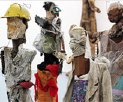 Dilomprizulike, 'Waiting for the bus'
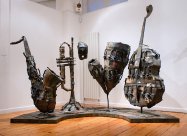 Romauld Hazoume, 'Made in Porto Novo'
At the same time African artists left on the continent looked squarely at their feet and their surroundings to make strong statements on the impact of globalization on their continent; nowhere else on the planet has become so inventive in creating sculptures, installations and craft made from recycled found objects.
In this capacity, I believe African artists have created a truly unique art form and have bequeathed a new art context to the world.
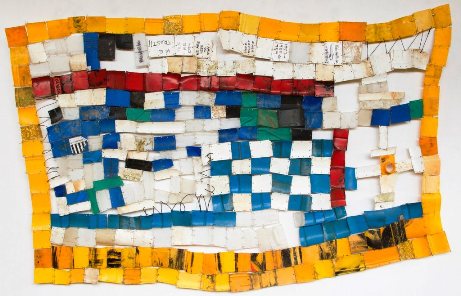
Serge Attukwai Clottey, b 1985, Accra, Ghana cuts up small squares of plastic from the myriad of plastic containers that are strewn around Ghana, mostly used in a secondary capacity for fetching water. They are essentially plastic tapestries that also incorporate other found objects.
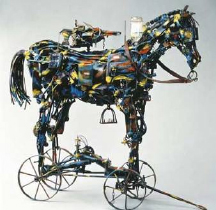 Willie Bester, Trojan Horse II, 1994
Mixed media assemblage
Willie Bester, b 1956, South Africa has been creating assemblage pieces for years and can certainly be judged the forefather of this media. He is socially and politically driven to make powerful pieces that demand recognition despite, or in some cases because of, the materials he has used to construct his installations and sculptures.
Africa's rapid and generally chaotic urban expansion has led to the growth of a number of popular new art forms that are quirky and very self expressive:
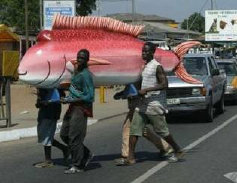 Fantasy Coffin making
- Fantasy coffin making, Ghana
- Sign-art, sign writing, poster making, Ghana and DRC
- Bollywood photography and film making, Nigeria
- Nigeria Cigarette cards
- Abidjan Phonecard sculptures, DRC

Exhibitions
There have been a number of exhibitions in recent times that have been paramount to establishing contemporary African art on the Western art front.
1984 - 'Primitivism in 20th C Art' - MOMA Exhibition, New York. Widely criticized for promoting African art as primitive and non secular while its Western counterparts were seen as 'modern', it nonetheless brought attention to the beauty of form thus exhibited.
1989 - 'Magicians de la Terre' - Centre Pompidou, Paris. This exhibition teamed primitive or folk artist like Kane Kwei with the so-called avant-garde. It revealed more about the curator than the reality of the artistic scene on the African continent as preference was given to artists who exhibited traces of tradition like feathers, pigments etc. However it did bring some unexposed African artists into the limelight and showed them alongside others from all over the world placing them in a very contemporary context which was a first.
1995 - 'Seven Stories about Modern Art in Africa' - Whitechapel, London. Attempting to provide a historical context for African modernism, it showed the work of 60 artists and the collaboration of 5 African curators.
2001 - 'The Short Century: Independence and Liberation movements in Africa, 1945-1994' - New York City. A highly ambitious exhibition, it installed 400 works on 3 floors of all media forms from all over Africa.
2001 - 'The Artist and the City' - Barcelona. After the millennium, there is a gradual inclusion of African artists in global forums like the Venice Biennale.
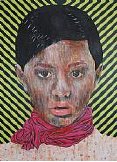 Mustafa Maluka, 'I can't believe you think that of me', 2007
2005 - 'Wealth of Africa: 400 yrs of Money and Trade' - British Museum
2004 - 'Africa Remix' - traveling exhibition conceptualized by Simon Njami, Cameroon. 2005 - exhibition showed in Southbank, London with 25 countries represented by 60 artists, some resident in Africa and others part of the diaspora.
2006 - Johannesburg Art Gallery, showed 200 pieces by 87 artists.
2008 - 'Angaza Africa' - October gallery, London, showcased their choice of 12 of Africa's most innovative and dynamic artists.
2008 - 'Flow' - Studio Museum, Harlem focused on a new generation of young artists who mostly lived abroad and visited Africa regularly.
2009 - 'Afro Modern, behind the masks' - Tate Modern, Liverpool
2010 - 'Space; Currencies in Contemporary African Art' Museum Africa, Johannesburg
There are three other areas which have contributed hugely to the maturing of the Contemporary African art scene, adding increased value and authenticity to the works of African artists and arousing public awareness and interest, both on the continent and abroad:
Contemporary African art books and periodicals
Periodicals/Magazines:
- Revue Noire
- Africa Arts
- Nka
- Journal of Contemporary African Art
- Critical Interventions
- Art South Africa
- Art throb
- The South African Art Times
- ArtAfrica
Books:
- 1966, Africa's Contemporary Art and Artists, Harmon Collection
- 2005, African Art Now, Masterpieces from the Pigozzi Collection
- 2006, Africa Remix, Jean Loupe Amselle
- 2008, Angaza Africa, Chris Spring
- 2009, South Africa Art Now, Sue Williamson
- 2010, Contemporary African Art since 1980, Okwui Enwezor
Auctions of Contemporary African art
Auction houses who deal in contemporary and modern African art include Bonham's, Christie's, Sotheby's, Phillip de Pury, Stephan Welz & Co, Aspire, Arthouse Contemporary Ltd
Contemporary African Art Shows and Fairs
Art X Lagos, Lagos, West Africa
Dak'Art Biennale, Dakar, Senegal
FNB Art Joburg, Johannesburg, South Africa
Triennale, Luanda, Angola
Investec Art Fair, Cape Town, South Africa
1:54 Contemporary African Art Fair, London, New York and Morocco
AKAA, Paris, France
RMB Latitudes, Johannesburg
Contemporary African art museums and public galleries
Zeitz Museum of Contemporary Art Africa, Cape Town, SA - founded in 2017, it exhibits almost exclusively art from the 21st Century from both emerging and established contemporary African artists.
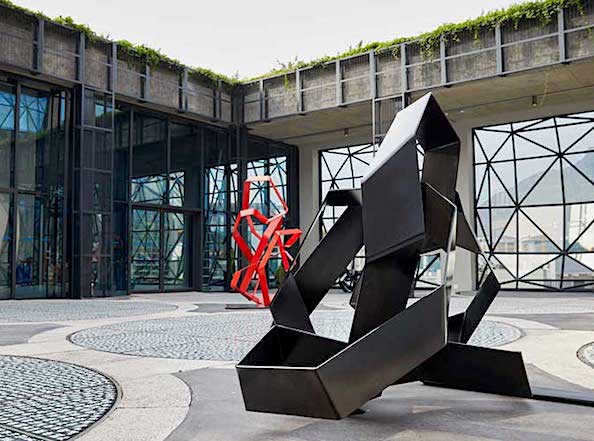 Zeitz Museum, rooftop sculpture garden
Museum of Contemporary Art Al Maaden, (MACAAL) Marrakech, Morocco, founded in 2018
Museum of Black Civilizations (MCN), Dakar, Senegal, founded in 2018
Norval Foundation, Cape Town, opened in 2018, it is a centre for art and cultural expression from SA and beyond.
Are you
an artist
from
Africa?
Do you want to exhibit your work globally?
You can do so right here and now by building a web page of your own within this web site.
The cost? It's completely free.
Click here and you'll be 'live' in minutes.
Do you
have an
African
art gallery?
Do you want to publish your gallery and exhibit your work globally?
You can do so right here and now by building a page in this website.
It costs you nothing but a few minutes of your time.
Click here and you'll be 'live' in minutes.
African Art newsletter subscribe free
Contemporary African Art Newsletters,Back Issues
# 001 - # 024
Recent Articles


-
African Art
 While the focus of this site is contemporary African art, I believe it is essential to understand what has gone before...
 -
Between Harmony and Inquiry: A Critical Review of Ifeoluwapo Rachael Okunade, Female Fine Art Photographer 2025
 Ifeoluwapo Rachael Okunade is a UK-based fine art photographer whose practice contributes meaningfully to contemporary visual culture through a sustained,
 -
Ifeoluwapo Rachael Okunade- Fine Art Photographer | Founder of Rae Gallery and Art
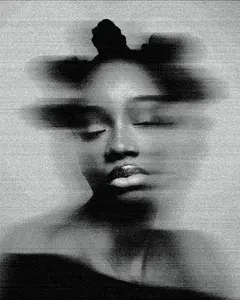 I’m Ifeoluwapo Rachael Okunade, a fine art photographer based in the United Kingdom. I founded Rae Gallery and Art in 2018, inspired by a deep love
 -
Oluwatobi Ogundunsin – Fine-Art Photographer | Founder of BigRexvisuals
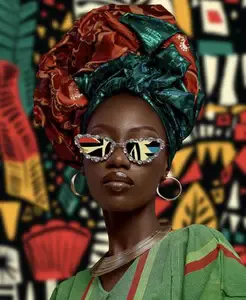 I’m Oluwatobi Ogundunsin, a fine-art photographer based in the UK and the founder of BigRexvisuals. Since 2016, my practice has focused on portraiture
New! Comments
Have your say about what you just read! Leave me a comment in the box below.